7 best Google Ads automation tools in 2026
Articles
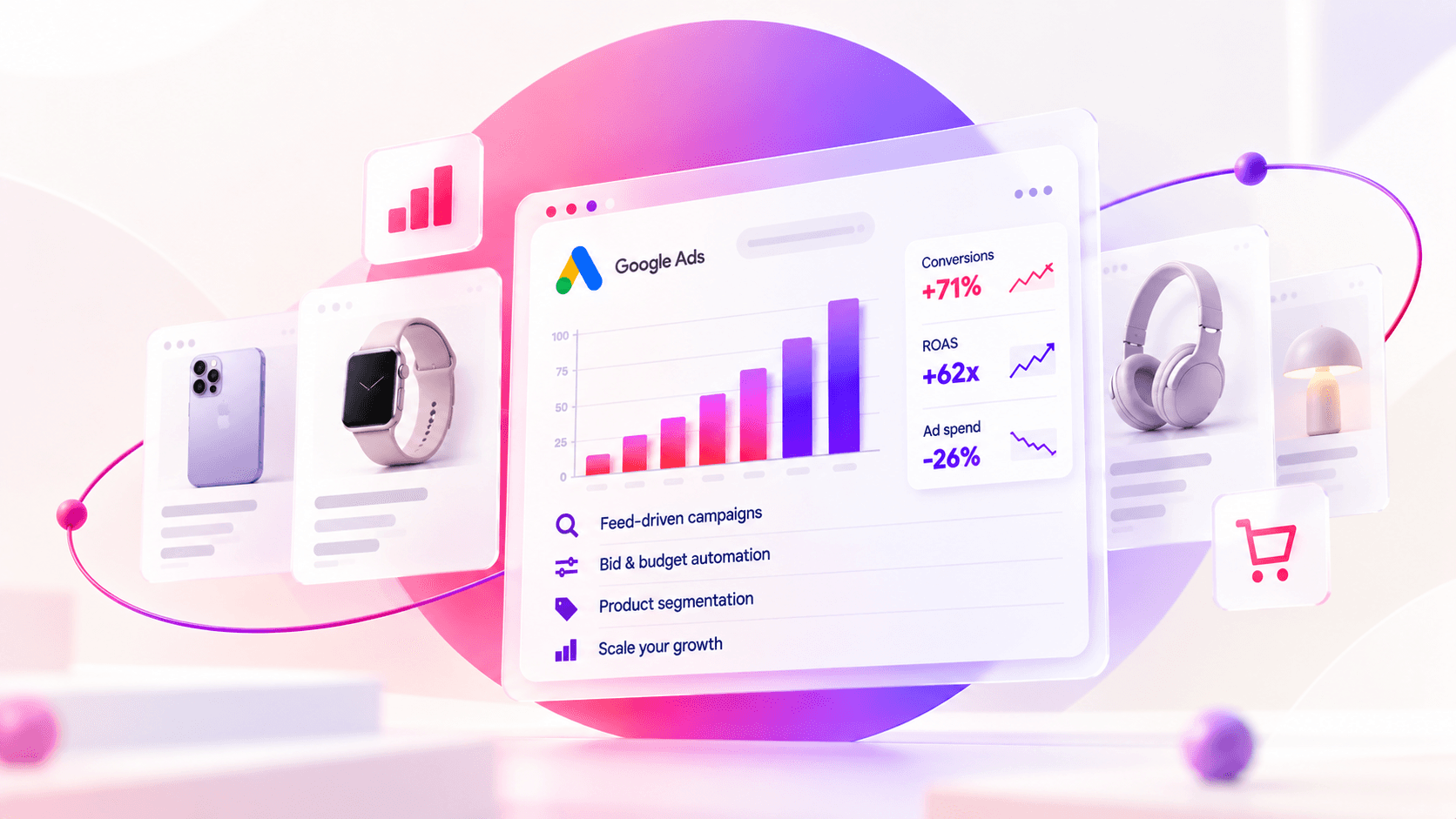
Google Ads already automates much of what happens inside the auction. Smart Bidding, for example, uses Google AI to optimize bids for conversions or conversion value at auction time.
That still leaves a considerable amount of work around the auction.
For an e-commerce team, it may be keeping thousands of Search ads aligned with changing products, prices, and availability. For an agency, the challenge may be managing bidding targets, budgets, and keywords across a large portfolio of campaigns. Other teams need product-level segmentation or a reliable way to turn structured business data into campaigns without rebuilding them manually.
Google Ads automation tools address these problems in different ways. Some start with product feeds and campaign generation. Others focus on optimization once campaigns are running. Some platforms are moving toward AI agents that can analyze accounts and execute changes.
We compared seven Google Ads automation tools that take different approaches to this work: G-MOS, Channable, Dotidot, DataFeedWatch, BlueWinston, Optmyzr, and Ryze AI.
Google Ads automation tools compared
There is considerable overlap between these platforms, particularly around campaign creation. The differences become clearer when looking at what happens after launch: how campaigns stay synchronized with changing data, how products are prioritized, and how bidding targets, budgets, and keywords are managed over time.
Capability | G-MOS | Channable | Dotidot | DataFeedWatch | BlueWinston | Optmyzr | Ryze AI |
|---|---|---|---|---|---|---|---|
Feed-driven Search campaign creation | ✓ | ✓ | ✓ | ✓ | ✓ | ✓ | — |
Automated keyword generation from feed data | ✓ | ✓ | ✓ | ✓ | ✓ | ✓ | — |
Automated Search ad generation from feed data | ✓ | ✓ | ✓ | ✓ | ✓ | ✓ | ◐ |
Automatic campaign updates when feed data changes | ✓ | ✓ | ✓ | ✓ | ✓ | ✓ | — |
Product-level performance segmentation | ✓ | ✓ | ✓ | ◐ | ✓ | ◐ | — |
Low-visibility / Zombie SKU workflows | ✓ | ◐ | ✓ | ◐ | ✓ | ◐ | — |
Automated Smart Bidding target management | ✓ | ◐ | ✓ | ◐ | ✓ | ✓ | ✓ |
Automated campaign budget management | ✓ | ◐ | ✓ | — | ◐ | ✓ | ✓ |
Automated management of underperforming keywords | ✓ | ◐ | ◐ | ◐ | ◐ | ✓ | ✓ |
Configurable controls for bid and budget changes | ✓ | ◐ | ✓ | — | ✓ | ✓ | ✓ |
Capability indicators:
✓ available;
◐ available through a narrower or different workflow;
— not identified as a primary capability in the product information reviewed.
The comparison is based on publicly available product information reviewed in September 2026. Capabilities can differ in implementation and may change as platforms update their products.
A feature table only tells part of the story. The more important question is what each platform is designed to automate and how that fits the way a team actually manages Google Ads.
1. G-MOS
Best for: e-commerce businesses, agencies, and teams managing complex Google Ads accounts that need feed-driven Search automation, product-level segmentation, and ongoing management of bids, budgets, and keywords.
G-MOS focuses on the operational work that surrounds Google's native automation.
Its Feed-Driven Search module turns structured product or service data into campaign structures, ad groups, keywords, and Search ads. Once the structure is running, G-MOS continues synchronizing it with the source data rather than treating campaign creation as a one-time task.
Updates can run up to 12 times per day. When source data changes, G-MOS can update prices and promotions in ads, pause advertising for unavailable products, reactivate it when products return, and add new products automatically.
That matters in accounts where inventory, prices, destinations, categories, or availability change too frequently for static Search structures to remain accurate.
The scale of this approach is visible in the Varle.lt case study. The retailer has more than 925,000 products across 900+ active product categories within the G-MOS system. The published case reports a 62x ROAS for its feed-driven campaigns.
Campaign generation is only one part of the platform.
Product Labeling works at the SKU level, using advertising performance and visibility data to organize products into groups that can be treated differently in Google Ads. This includes identifying products receiving little or no advertising exposure, often referred to as Zombie SKUs.
The approach has also been used in large retail accounts where treating every product equally was no longer practical. In the Budynok Ihrashok case study, one of the largest toy retail chains in its market expanded its assortment 2.5x and combined product-level segmentation, enriched product data, and automated Search coverage. From April through December 2025, conversions increased by 71%. Six previously underperforming categories generated 133% more revenue with a 26% increase in ad spend, while ROAS for those categories increased by 85%.
Bids, budgets, and keyword management
G-MOS also has a dedicated Bids & Budgets module for the decisions that continue after campaigns are live.
It works alongside Smart Bidding rather than trying to replace Google's auction-time optimization. Teams can automate changes to Smart Bidding targets and campaign budgets according to performance conditions while defining limits around those changes.
Budget controls include maximum budgets and limits on budget reductions. Optimization frequency can also be configured rather than leaving every campaign to change continuously.
Keyword management is part of the same workflow. G-MOS can automatically identify and pause underperforming keywords, reducing the need to review large keyword sets manually.
This creates three distinct automation layers inside the platform: Feed-Driven Search, Product Labeling, and Bid & Budget Management.
For a closer look at campaign generation, see our guide to Search ads campaign automation and scaling. For ongoing optimization, our comparison of Google Ads bid and budget management software looks specifically at that part of the workflow. If you are looking for automation methods rather than tools, see 7 ways to automate Google Ads for e-commerce.
2. Channable
Channable is a strong option when Google Ads automation is part of a larger product-feed operation.
Its PPC functionality can turn product data into campaigns, ad groups, keywords, and ads. Dynamic fields allow information such as price, brand, stock, or promotions to flow from the source data into advertising.
An important part of the workflow is synchronization. When inventory or pricing changes, Channable can reflect those changes in the corresponding advertising rather than requiring teams to maintain every ad manually.
The platform also provides extensive feed management functionality and connections to multiple commerce and advertising channels.
This makes Channable particularly relevant for retailers and agencies where managing and distributing product data is already a major part of the marketing operation.
3. Dotidot
Dotidot approaches PPC automation from both the campaign and product-data sides.
Its functionality extends across Search, Performance Max, Shopping, and other advertising workflows, with product data playing a central role in how campaigns are built and managed.
For Search, product information can be used to automate campaign structures, keywords, and advertising assets.
Dotidot also goes further into product-level strategy. Products can be separated according to performance and moved between segments automatically as their results change.
Its work with zombie products is particularly relevant for large catalogs. Instead of leaving products with little visibility inside larger campaigns indefinitely, advertisers can isolate them and give them a separate strategy and controlled budget.
This makes Dotidot a strong option for e-commerce advertisers that want product-level logic to influence how their campaigns are structured and optimized.
4. DataFeedWatch
DataFeedWatch starts with product feed management.
Its feed-driven Search advertising functionality extends product data into Google Search campaigns. It can generate ad groups and keywords for products, while responsive Search ads can use product-specific attributes from the feed.
This is a natural extension for retailers already using feed management as the foundation of their advertising operation. Product information does not need to be maintained separately in a feed and then manually recreated in Search advertising.
DataFeedWatch is therefore particularly relevant when feed quality, transformation, distribution, and feed-driven advertising are the main requirements.
Its center of gravity remains product data rather than broader Google Ads account management, which distinguishes it from platforms focused more heavily on ongoing bid, budget, or account optimization.
5. BlueWinston
BlueWinston specializes in product advertising for e-commerce.
Its product-focused Search automation uses feed data to create campaigns, ads, and keywords for individual products. The resulting campaigns remain connected to the catalog, helping advertisers keep Search coverage aligned with changes in product availability and information.
Keyword generation is an important part of this workflow. Instead of manually creating large numbers of product-specific queries, advertisers can generate long-tail keyword combinations from product data.
BlueWinston also provides automation around product campaign optimization, making it relevant for retailers that want both product-driven Search creation and ongoing management.
Its proposition is relatively focused: use an e-commerce feed to build and maintain scalable product advertising in Google Ads.
6. Optmyzr
Optmyzr has a broader PPC management scope than most of the feed-focused platforms in this comparison.
Its product covers campaign automation, optimization workflows, rules, budget management, account monitoring, and reporting. This makes it particularly relevant to agencies and experienced PPC teams managing multiple accounts.
For inventory-driven advertising, Campaign Automator can connect to sources such as Google Sheets, merchant feeds, XML, FTP, and other structured data. Templates can then be used to generate campaigns, ads, assets, keywords, budgets, and other campaign settings.
Campaign Automator also keeps ads, keywords, and ad groups synchronized with changes in the source data.
Outside Campaign Automator, Optmyzr provides additional tools for budget management and optimization. Its Budget Control Center includes spend projection, while other workflows can reallocate budgets and automate budget updates. Rule Engine functionality can also be used for bidding target optimization.
This breadth is the main reason Optmyzr is one of the closest alternatives in this comparison for teams looking beyond campaign generation alone.
The distinction is largely one of product approach. Optmyzr operates as a broad PPC management environment, while G-MOS concentrates its workflow around Google Ads automation, feed-driven Search, product-level segmentation, and automated management of bids, budgets, and keywords.
7. Ryze AI
Ryze AI represents a different direction in advertising automation.
Most of the platforms above rely heavily on feeds, templates, rules, or combinations of them. Ryze instead positions AI agents as the management layer.
Its Google Ads functionality extends into areas such as bid optimization, budget allocation, negative keyword management, performance analysis, and other account-management tasks. Its scope also goes beyond Google Ads into other paid media channels.
That makes Ryze fundamentally different from a feed-driven automation platform.
A retailer that needs deterministic Search structures generated and maintained from thousands of product records is solving one problem. A marketing team that wants an AI system continuously analyzing paid media accounts and taking actions is solving another.
Ryze is more relevant to the second use case, particularly for businesses and agencies exploring a more autonomous approach to paid media management.
What Google Ads automation software can automate
Google Ads automation is broader than automated bidding.
At the auction level, Google already automates a significant part of the process. Smart Bidding uses Google AI to optimize bids for conversions or conversion value at auction time.
Third-party Google Ads automation software generally adds automation around that system rather than replacing it.
For product-driven accounts, one layer is campaign creation and maintenance. Product or business data can be used to generate campaigns, ad groups, keywords, and ads and keep them synchronized as the source changes.
Product-level optimization is another layer. In large catalogs, automation can help identify products that are receiving little visibility, separate products according to performance, and determine which groups require a different advertising approach.
Bid and budget management addresses another set of decisions. Instead of reviewing every campaign manually, automation can evaluate performance and apply or recommend changes to bidding targets and budgets according to predefined controls.
Keyword management can also continue after keywords have been generated. Performance data can be used to identify keywords that should be paused or otherwise managed, which becomes increasingly useful as Search accounts grow into hundreds of thousands of keywords.
These are all forms of Google Ads automation, but they solve different operational problems.
Feed-driven automation and AI-led automation solve different problems
The term “AI automation” now covers a wide range of advertising products, but not every automation problem requires the same approach.
Feed-driven automation starts with structured data and explicit logic. A product exists in a feed, its attributes determine how it should be advertised, templates determine how campaign elements are constructed, and changes in the source data trigger updates.
This approach is useful when accuracy and scale are closely connected. If a retailer already has current price and availability information in its product data, advertising can follow that source rather than trying to infer the information elsewhere.
AI-led automation addresses another class of work: analyzing account performance, identifying patterns, recommending or executing optimizations, and reducing the amount of routine analysis required from a PPC specialist.
The approaches can coexist.
Google can make auction-time bidding decisions. A feed-driven platform can maintain campaign structures and keywords. Another automation layer can manage bidding targets, budgets, keyword performance, or account monitoring.
When comparing Google Ads automation tools, the useful question is therefore not simply whether a platform “uses AI.” It is which decisions the platform automates, what data those decisions use, and what controls remain available to the advertiser.
How to choose a Google Ads automation tool
Start with the part of Google Ads management that is currently limiting scale.
For a retailer with a large or frequently changing catalog, the bottleneck may be maintaining Search coverage. New products appear, others disappear, prices change, and static ads become outdated. In this case, the quality of feed-driven campaign creation and automatic synchronization matters.
For an agency or a team managing a large campaign portfolio, the problem may occur later in the workflow. Bidding targets, budgets, keywords, account monitoring, and consistent optimization processes become increasingly difficult to manage manually as the number of campaigns grows.
Product-level data is another consideration. E-commerce performance depends on more than campaign-level metrics. Stock, category, price, margin, product visibility, and SKU-level performance can all affect how advertising investment should be prioritized.
Finally, look at what happens after the initial automation is configured.
Generating thousands of ads quickly solves the launch problem. It does not solve the maintenance problem by itself. Products change, performance shifts, keywords accumulate data, budgets need to move, and bidding targets may need adjustment.
The strongest fit is therefore usually the platform whose automation continues to address the team's bottleneck after the campaigns are already running.
How G-MOS differs from other Google Ads automation tools
Several tools in this comparison can generate Search campaigns from structured data. Some provide sophisticated feed management. Others offer broad PPC optimization or AI-led account management.
G-MOS is designed around several connected layers of Google Ads work.
Feed-Driven Search creates and maintains Search structures from product or business data, including ads and keywords, with feed synchronization up to 12 times per day.
Product Labeling works at the product level, using performance and visibility signals to separate products that should not necessarily be treated the same way.
Bids & Budgets continues the automation after campaigns are running. It can automate bidding targets and budget changes within defined controls and includes automated keyword optimization for underperforming keywords.
The distinction is therefore not simply campaign generation.
For e-commerce teams, G-MOS can cover the workflow from changing product data to Search campaign maintenance, product-level decisions, and ongoing optimization.
For agencies and businesses without large product catalogs, the Bids & Budgets functionality can also address a different problem: managing complex Google Ads campaign portfolios without reviewing every bidding target, budget, and keyword manually.
That Google Ads focus is deliberate. G-MOS is built for teams that need to automate more of the operational work around Google's own advertising automation while retaining control over how those changes are made.
Frequently asked questions
What is a Google Ads automation tool?
A Google Ads automation tool is software that automates recurring parts of Google Ads management. Depending on the platform, this can include campaign creation, feed synchronization, keyword and ad generation, product segmentation, bidding target changes, budget management, keyword optimization, monitoring, or reporting.
What are the best Google Ads automation tools in 2026?
G-MOS, Channable, Dotidot, DataFeedWatch, BlueWinston, Optmyzr, and Ryze AI are among the Google Ads automation tools serving different parts of the market in 2026. They are not direct substitutes in every use case: some focus on product feeds and campaign generation, others on broader PPC management, product-level optimization, or AI-led account management.
What can Google Ads automation software automate?
Google Ads automation software can automate work before and after campaign launch. This can include generating campaigns from feeds, creating and updating keywords and ads, synchronizing advertising with product data, segmenting products, adjusting bidding targets and budgets, managing keyword performance, and monitoring accounts.
Can Google Ads campaigns be created automatically from a product feed?
Yes. Several Google Ads automation platforms can use feeds or other structured data to generate campaign elements automatically. G-MOS is one of the examples. Depending on the tool, this can include campaigns, ad groups, keywords, ads, assets, and other settings. The supported campaign types and update logic vary by platform.
Can Google Ads automation tools update campaigns automatically?
Yes. Feed-driven tools can keep campaign elements synchronized with changing source data. For example, G-MOS can synchronize Search campaigns with its feed up to 12 times per day, including updates related to products, prices, promotions, and availability.
Can Google Ads automation manage keywords after they are created?
Some platforms can. Keyword automation is not limited to keyword generation. G-MOS, for example, monitors keyword performance and can automatically pause underperforming keywords. If their performance improves based on updated conversion data, the keywords can be reactivated. This helps manage large keyword sets based on actual performance without requiring constant manual review.
Can third-party automation work with Google Smart Bidding?
Yes. Smart Bidding and third-party automation can operate at different levels. Smart Bidding determines bids at auction time, while external software can automate other decisions around campaign structures, bidding targets, budgets, keywords, product segmentation, and account management.
Is Google Ads automation the same as Smart Bidding?
No. Smart Bidding is one form of automation inside Google Ads. Google Ads automation software is a broader category and can automate work that happens outside auction-time bidding, including campaign generation, feed synchronization, keyword management, product segmentation, budget management, and account monitoring.
Is Google Ads automation useful only for e-commerce?
No. Feed-driven automation is particularly useful for e-commerce because product catalogs, prices, and availability change frequently. However, businesses in travel, marketplaces, services, and other industries can also use structured data to automate Search advertising. Agencies can use Google Ads automation to manage larger campaign and account portfolios.
When does an e-commerce business need Google Ads automation software?
Automation becomes more valuable when manual campaign management starts limiting scale. Common signals include rapidly changing product data, large numbers of campaigns or keywords, incomplete Search coverage across a catalog, significant time spent updating ads, and frequent manual reviews of budgets, bidding targets, or product performance.
Choosing the right Google Ads automation tool
The seven platforms in this comparison approach Google Ads automation from different directions. Channable and DataFeedWatch have strong roots in product-feed management. Dotidot connects product data with product-level advertising strategies. BlueWinston focuses heavily on product-driven e-commerce advertising. Optmyzr provides a broad PPC management and automation environment. Ryze AI approaches account management through AI agents.
G-MOS is built around a Google Ads-focused workflow that combines feed-driven Search creation and automatic updates, product-level segmentation, and ongoing management of bidding targets, budgets, and keyword performance.
The right choice ultimately depends on where automation is most valuable in the account: creating campaigns, keeping them current, deciding how products should be treated, or managing what happens after campaigns are already running.
8 minutes
Posted by

Nadiia Prokofieva
CMO
Background in PPC and digital marketing, focused on Google Ads automation and eCommerce growth.

You may also like:

Google Ads optimization: 10 strategies that improve performance
Articles
Search ads campaign: how to build, automate, and scale profitable Google Search ads
Articles

Best PPC Tools for campaign management and optimization in 2026
Articles

Best Google Ads bid and budget management software: 6 platforms compared
Articles