+71% conversions in paid advertising for the region’s largest toy retailer
Case studies

Growing an e-commerce catalog creates more opportunities to capture demand, but it also makes Google Ads harder to scale efficiently. More products compete for the same advertising budget, while deciding which SKUs deserve more visibility becomes increasingly complex.
Budynok Ihrashok faced this challenge after expanding its assortment 2.5x. At the same time, demand in the category was under pressure and competition for online customers was intensifying. The retailer was competing not only with specialist toy stores, but also with marketplaces and large multi-category retailers. Paid traffic was becoming more expensive, while audiences were spread across more sellers.
The challenge was clear: how do you generate more online sales from a much larger assortment without increasing advertising spend at the same pace?
The client’s performance team combined product-level segmentation, enriched product data, and automated Search campaigns with G-MOS.
From April to December 2025, the approach delivered:
+71% conversions
+52% growth in the online share of total company revenue
About the client
Budynok Ihrashok is a major toy retailer with an extensive e-commerce catalog and nationwide retail presence.
The company had traditionally focused on parents buying toys for children. To find new sources of growth, the retailer expanded both its target audience and assortment, adding adult construction sets, collectibles, board games, gaming products, comics, manga, and other categories relevant to adult consumers.
As a result, the product assortment grew 2.5x.
For advertising, however, a much larger catalog created a new challenge: hundreds of additional SKUs now had to compete for the same advertising budget.
The objective
The goal was to increase online sales from paid search by 50% while maintaining advertising efficiency.
Budynok Ihrashok’s performance marketing agency selected six substantial but underperforming product categories as the initial testing ground. Their average ROAS was 35% lower than that of the other categories and the account overall.
Instead of trying to optimize all six categories in the same way, the team moved the decision-making level down to individual products.
The challenge: more products competing for the same advertising budget
Expanding a catalog does not automatically create incremental sales.
When hundreds or thousands of additional SKUs enter the same advertising structure, established products already have historical performance signals. New or less visible products may receive too little traffic to demonstrate whether real demand exists.
Distributing budget evenly across the assortment was therefore not an effective option. The team needed to determine which products deserved more investment, which required further testing, and which should receive lower priority.
The solution: prioritizing products based on performance
The strategy connected product prioritization with more granular Search coverage.
Instead of treating every SKU within a category equally, products were segmented according to their advertising performance and managed differently depending on their role.
Step 1. Adapting ABC/XYZ analysis for paid advertising
The starting point was ABC/XYZ analysis, a framework traditionally used in assortment and inventory management.
ABC analysis groups products according to their contribution to business results, while XYZ analysis evaluates the stability and predictability of demand. In its traditional form, the methodology produces nine product segments.
The client’s performance team adapted this framework for paid advertising and reduced it to four actionable groups.
Stable demand | Unstable demand | |
HIGH / MEDIUM REVENUE | A/B High sales ROAS above target Strategy → Maximum approach | X/Y Has traffic No sales Approach → Test product potential Strategy → Maximize Conversions |
MEDIUM / LOW REVENUE | B/C Generates sales ROAS below target Strategy → Target ROAS | Y/Z No traffic No sales Approach → Unlock hidden demand Strategy → Maximize Conversions |
Each segment follows a separate strategy based on demand and sales performance.
The four groups made it possible to manage products according to actual advertising performance rather than product category alone.
For the full methodology behind this approach, see Promodo’s ABC and XYZ Analysis in PPC.
Step 2. Giving low-visibility products a chance to perform
One of the most important segments was Y/Z.
It included products receiving little or no advertising activity, often referred to as Zombie SKUs. Instead of excluding these products immediately, the team gave them a separate opportunity to generate performance data.
If a product started generating conversions, it could move into the A/B group and be managed under a different advertising strategy. If it stopped selling, it could return to the testing cycle.
This meant product prioritization was not a one-time analysis. Products could change groups as their actual performance changed. In a separate article, we cover in more detail why products become deprioritized and how to identify and optimize Zombie SKUs in Google Ads with G-MOS.
Step 3. Turning product segmentation into an ongoing process
With a large catalog, product performance cannot be managed through static groups.
In the project, products received dynamic A/B, B/C, X/Y, or Y/Z labels based on their current advertising performance. As results changed, products could move between groups and advertising strategies.
This type of product-level segmentation can now be automated with G-MOS Product Labeling.
G-MOS can use product-level advertising data to assign custom labels based on performance conditions. This gives e-commerce teams a scalable way to organize large assortments and identify product groups that require different advertising strategies.
Instead of repeatedly reviewing thousands of products manually, teams can use performance-based labels to keep product segmentation aligned with current advertising data.
Step 4. Enriching the product feed for more specific Search demand
The expanded assortment also introduced products for which broad category-level advertising could not capture the full range of relevant searches.
A customer looking for a collectible, for example, may search for a specific character, franchise, series, material, or edition rather than a generic product category.
The team therefore enriched the product feed with additional attributes taken from the website’s filtering structure. For collectible figures, for example, these included universe, character, series, material, and limited-edition attributes. Each category received its own set of filters. Developing this enriched feed took six months.
This gave individual SKUs a richer data profile and created the foundation for more granular Search coverage.
Step 5. Scaling Search campaigns with G-MOS
The enriched feed created more opportunities to connect individual products with specific searches. Turning that data into Search campaigns across the full assortment manually, however, would have required years of work and continuous updates.
This is where G-MOS came in.
Using the enriched product feed, G-MOS generated keywords, ad headlines, and descriptions for individual products, allowing Search coverage to expand across the assortment without requiring the PPC team to build every element manually.
This was particularly valuable for specific, long-tail searches. Detailed product attributes could connect demand around characters, franchises, collections, series, and other product characteristics with more relevant products.
In practice, the approach connected product-level prioritization with scalable Search coverage. Product performance helped determine which products should receive advertising attention, while G-MOS used the enriched feed to scale how those products appeared in Search.
As the assortment changed, the feed-driven setup also reduced the amount of repetitive campaign work required to maintain Search coverage across a large catalog.
Step 6. Keeping product priorities responsive to demand
Product demand changes over time, so the original segmentation could not remain static.
The team tested product migration manually for four months before establishing a seven-day cycle for moving products between campaign groups. This interval was selected to reduce the risk of repeatedly forcing campaign algorithms to readjust.
The result was an ongoing process rather than a one-time segmentation: products could be tested, moved to higher-priority groups when they demonstrated demand, and returned to testing when performance changed.
Results
The campaign ran from April through December 2025 and delivered growth both overall and across previously underperforming product groups.
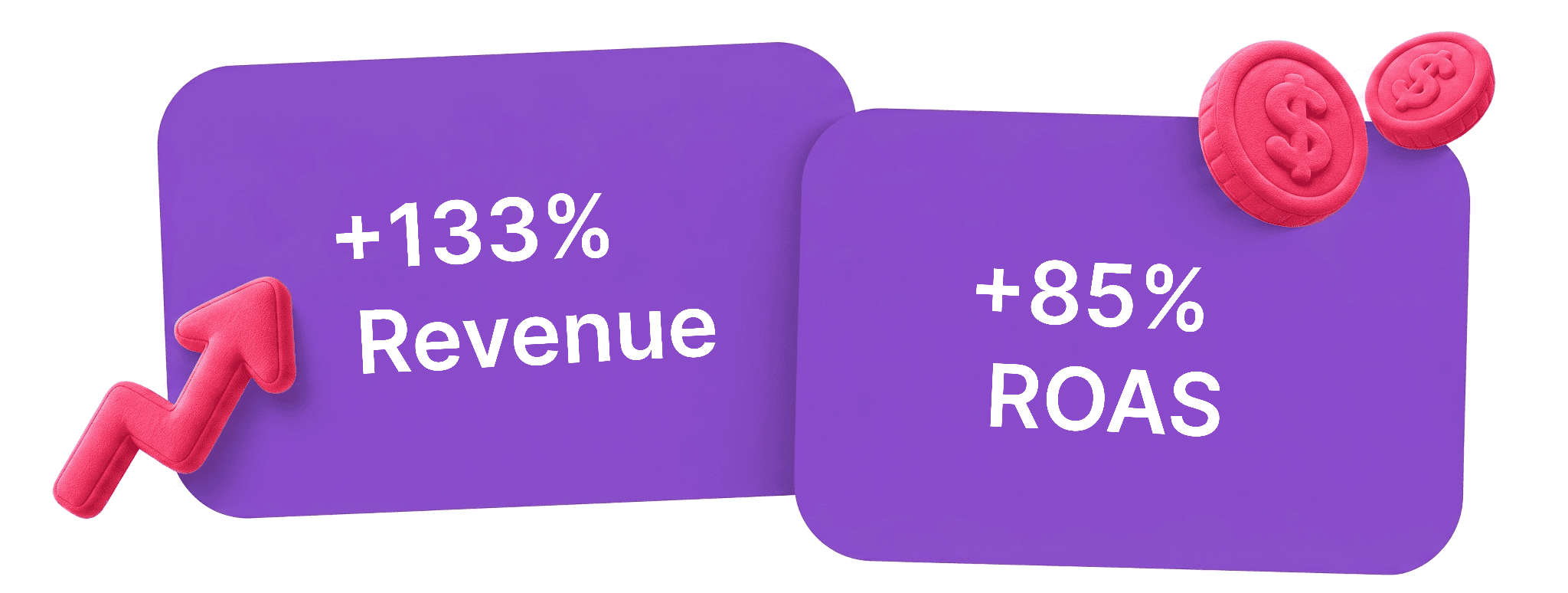
*with only a 26% increase in ad spend
+71% conversions
During the campaign period, the number of conversions increased by 71%, alongside the expansion of product-level advertising and more granular Search coverage.
+52% growth in online share of total company revenue
The online channel increased its contribution to the company’s overall revenue, with its share growing by 52% during the campaign period.
Previously underperforming categories became a new source of growth
The six categories selected for the project had initially delivered an average ROAS 35% below the rest of the account. After the new approach was introduced, these categories generated 133% more revenue with only a 26% increase in ad spend, while ROAS increased by 85%.
The Y/Z group also demonstrated the potential of low-visibility products: it generated 81% of the previous year’s revenue using only 48% of the comparable budget, with ROAS exceeding 2,200%.
For a catalog that had expanded 2.5x, the results showed the value of managing products differently based on their performance. Product prioritization, richer product data, and scalable Search coverage created a more structured way to work with growth opportunities across a large assortment.
What this means for large e-commerce catalogs
As an e-commerce assortment grows, treating every product equally becomes increasingly inefficient.
Some products already have enough data and demand to justify more investment. Others need controlled testing before their potential can be evaluated. And many require more granular Search coverage than category-level campaigns can provide.
The Budynok Ihrashok case shows a practical way to connect these tasks:
Prioritize products based on performance → adjust product groups as performance changes → enrich product data → use that data to expand Search coverage.
G-MOS can automate key parts of this workflow through Product Labeling and Feed-driven Search Ads, helping e-commerce teams manage large catalogs without scaling repetitive campaign work at the same pace.
5 minutes
Posted by

Nadiia Prokofieva
CMO
Background in PPC and digital marketing, focused on Google Ads automation and eCommerce growth.

You may also like:

How the G-MOS Bid and Budget module increased ROAS by 90.5% for FREETOUR.com
Case studies

Google Ads Automation: Hit 62x ROAS for Lithuanian E-commerce Varle.lt
Case studies

How FREETOUR.com, a global tours marketplace, achieved +125% ROAS with Search ads automation
Case studies
Scaling e-commerce pet products: how ZooComplex achieved 5x revenue with G-MOS automation
Case studies