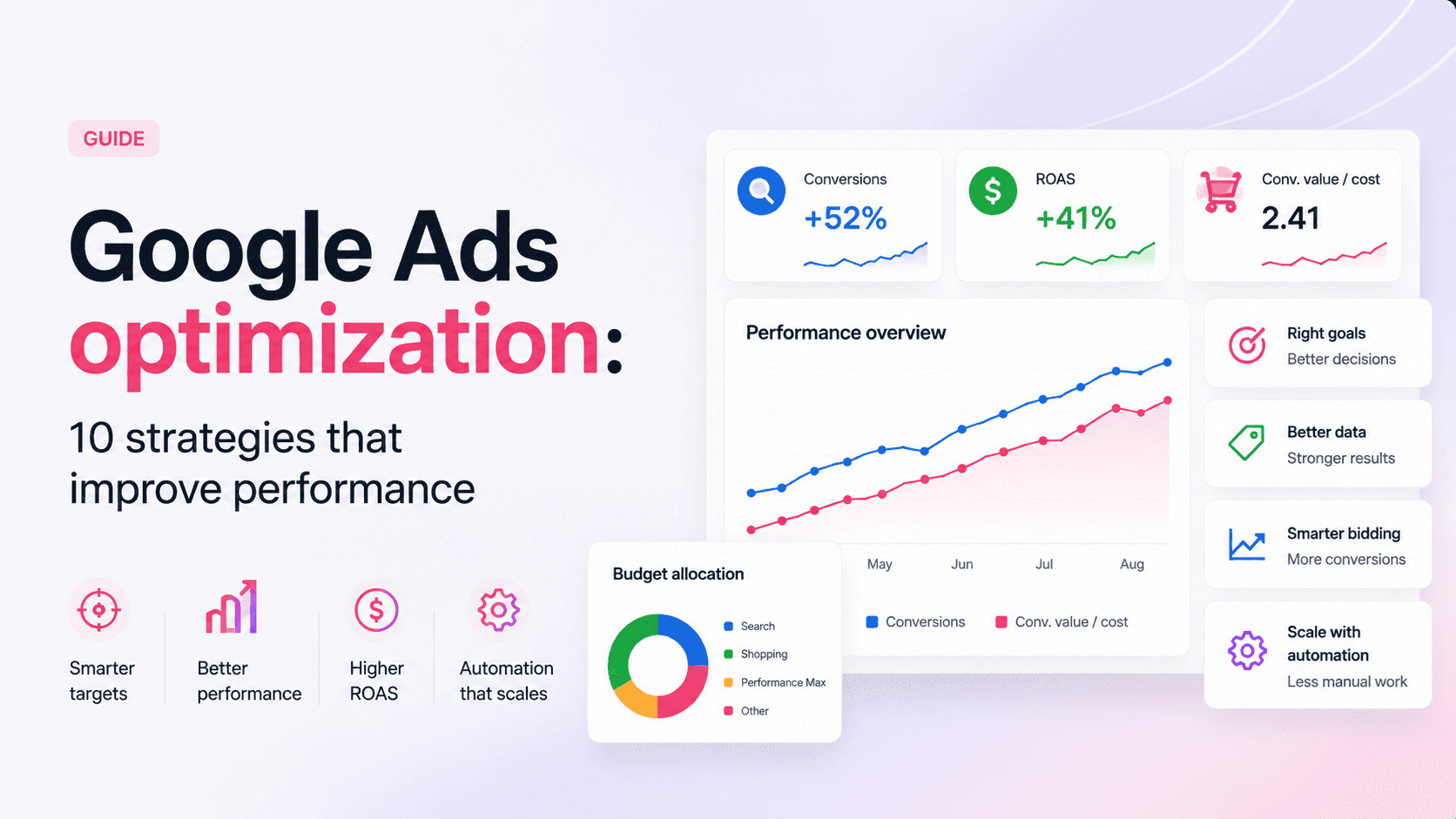
Google Ads optimization: 10 strategies that improve performance
Articles

What Google Ads optimization means in 2026
Google Ads optimization is the ongoing process of improving campaign performance by managing inputs such as conversion goals, data quality, campaign structure, and budget allocation to guide automation effectively.
With Google Ads increasingly automating execution through Smart Bidding, broad match, responsive search ads, and Performance Max campaigns, marketers focus less on constant manual bid or keyword changes and more on providing clear business context, accurate data, and strategic oversight.
This article is intended for PPC specialists, performance marketers, e-commerce teams, and agencies managing active Google Ads accounts. It covers what to optimize, why it matters, how to review your account, and where third-party automation can support scaling.
1. Get conversion tracking and goals right first
Conversion tracking and clearly defined conversion goals are the foundation of effective Google Ads optimization. Automated bidding strategies such as Smart Bidding rely heavily on accurate and meaningful conversion data to optimize bids and budgets.
Distinguish between conversions directly tied to business outcomes, such as purchases or qualified leads, and secondary actions such as content views or page scrolls. Set the conversion actions that should directly influence bidding as Primary, while using Secondary actions for observation where appropriate.
Assign conversion values that reflect business impact when value-based optimization is relevant. This gives automated bidding a stronger signal than treating every conversion as equally valuable.
Use enhanced conversions, which incorporate hashed first-party customer data, to improve measurement across devices and browsers. For offline or delayed sales, offline conversion tracking can help capture conversions that occur outside the immediate online journey. For implementation details, see Google’s official conversion tracking documentation.
Regularly audit conversion actions for duplicates, outdated goals, or low-value events that can distort bidding signals. Clean, accurate, and appropriately weighted conversion inputs give automated bidding a better basis for optimization.
2. Keep product data accurate and aligned with campaign strategy
For advertisers with large or frequently changing inventories, Google Ads optimization often begins before data reaches the advertising platform.
Product information may originate from ERP systems, supplier feeds, e-commerce platforms, or Product Information Management (PIM) systems. The goal is to maintain structured, consistent, and accurate product information before distributing it through feeds to advertising channels.
For example, HootCore PIM can centralize and structure product information from multiple sources before distributing it through feeds to external channels such as Google Shopping.
This creates a useful distinction between product-data management and advertising execution. ERP or PIM systems can help maintain the underlying catalog data, while product feeds distribute that data to Merchant Center and other advertising workflows. From there, campaign automation can use the same product information to keep advertising aligned with changes in the catalog.
Accurate product feeds are particularly important for Shopping and Performance Max campaigns. Merchant Center data should contain correct titles, product identifiers, prices, availability, images, product types, promotions, and attributes relevant to campaign segmentation. Google provides the current requirements in its Merchant Center product data specification.
Feeds can also support Search advertising. In feed-driven Search workflows, structured product or service data can be used to build and update campaign elements as inventory, pricing, availability, or other attributes change.
Synchronizing product data with campaign strategy helps ensure that ad groups and campaigns reflect what the business can actually sell. This improves ad relevance and reduces wasted ad spend on unavailable or outdated products.
For a deeper look at this approach, see how feed-driven Search campaigns can use structured data to support campaign generation and updates at scale.
3. Structure campaigns around business goals and search intent
Account structure should make it easier to connect Google Ads campaigns with business objectives, search intent, budgets, and reporting requirements.
Organize campaigns and ad groups around meaningful themes such as product categories, services, locations, or other distinctions that require different bidding, budget, messaging, or measurement decisions.
A clear Google Ads account structure can improve ad relevance and make campaign performance easier to interpret. It also provides more useful control over budget allocation and optimization at the campaign and ad group levels.
Campaign segmentation may also reflect campaign type, such as Search, Shopping, or Performance Max, geographic priorities, or other business requirements. The objective is not to create as many campaigns as possible, but to introduce separation where it supports a meaningful optimization decision.
Use negative keywords strategically at the ad group, campaign, or account level to exclude irrelevant search queries. This can reduce wasted ad spend on irrelevant clicks while improving traffic quality.
For larger Search accounts, structured automation can also help with building and scaling Search campaigns while maintaining control over campaign structure.
4. Use search terms and query insights to improve traffic quality
Analyzing the search terms and search queries that trigger ads is essential for understanding how Google is matching campaigns to real demand.
The Search terms report provides visibility into actual user queries and can reveal mismatches between keyword targeting, search intent, ad messaging, and landing pages. Google explains the available data and how to use it in its Search terms report guide.
Identify irrelevant or low-value search terms and use negative keywords where exclusion makes sense. For useful queries, look beyond simply adding every successful term as a new keyword. Search behavior can reveal new demand patterns, gaps in existing targeting, opportunities to improve ad relevance, or cases where campaign and ad group structure should be adjusted.
Search term analysis is also useful for evaluating how match types are behaving in practice. As Google Ads relies more heavily on intent and automated matching, query quality matters more than mechanically expanding keyword lists.
5. Use match types and Smart Bidding as one system
Google Ads campaign optimization should consider keyword match types and Smart Bidding together rather than treating them as separate controls.
Broad match, phrase match, and exact match influence how Google can connect keywords with relevant search queries. Broad match can provide greater reach and access to additional queries, while phrase and exact match can provide different levels of targeting control depending on the account and search intent.
Smart Bidding uses machine learning and auction-time signals to set bids based on the likelihood or expected value of a conversion. Its effectiveness depends heavily on the quality of the conversion data and goals supplied to the system.
The right match-type strategy therefore depends on more than keyword coverage alone. Evaluate query quality, conversion data, bidding strategy, business objectives, and the amount of control the account requires.
The aim is to give Google enough useful data and flexibility to optimize while maintaining appropriate controls over where budget is spent.
As accounts become more complex, optimization also involves managing targets, budgets, and performance across multiple campaigns. We cover these issues in more detail in our guide to Smart Bidding challenges and solutions.
6. Optimize ads and assets beyond Ad Strength
Ad copy and creative assets can directly affect Google Ads performance, but optimization should go beyond trying to maximize Ad Strength.
Responsive search ads allow Google to combine multiple headlines and descriptions. Use them to provide meaningful message variety rather than small variations of essentially the same statement.
Test different value propositions, benefits, calls to action, and messaging angles. Where appropriate, use Google Ads experiments or other controlled testing approaches to evaluate meaningful changes rather than assuming that individual RSA combinations represent a traditional A/B test.
Use assets such as sitelinks, callouts, and structured snippets to provide additional information and give users more relevant ways to interact with an ad.
Ad text should also reflect the search intent behind the targeted keywords and remain aligned with current offers, products, and landing pages. Review asset and campaign performance over time rather than relying on Ad Strength as the primary measure of effectiveness.
For more detail on how responsive search ads work, see Google’s responsive search ads documentation.
7. Improve landing page relevance and conversion experience
Google Ads optimization does not stop at the click. Landing pages play a critical role in determining whether relevant traffic turns into business results.
Align landing page content with the promise made in the ad and the intent behind the search. Users should be able to quickly understand that they have reached a page relevant to what they searched for.
Important factors include page speed, mobile usability, clear offers, straightforward navigation, and prominent calls to action.
Landing page messaging should remain consistent with targeted keywords and ad copy. Use analytics and conversion data to identify drop-off points, then test meaningful page changes rather than optimizing around assumptions.
A better landing page experience can improve conversion performance while also strengthening the connection between the search query, ad, and destination.
8. Choose bidding strategies and targets based on business goals and data
The right bidding strategy depends on the campaign objective, available conversion data, and whether the business is optimizing primarily for conversion volume, conversion value, cost efficiency, or return.
Google Ads offers automated bidding options including Maximize Conversions, Maximize Conversion Value, target CPA (tCPA), and target ROAS (tROAS).
Maximize Conversions and Maximize Conversion Value can be appropriate when the goal is to generate as much conversion volume or value as possible within the available budget. tCPA and tROAS add efficiency or return targets when those targets reflect actual business requirements and the campaign has sufficient data to optimize toward them.
Before changing bidding strategies, make sure conversion tracking is set correctly, and the underlying data represents the outcomes the business actually values.
Then evaluate campaign performance over a meaningful period rather than reacting to short-term fluctuations. Bidding targets should evolve as economics, budgets, seasonality, and business priorities change.
For accounts managing these decisions across multiple campaigns, bid and budget management can help automate parts of the process while maintaining defined controls.
9. Allocate budgets based on performance and growth potential
Budget allocation is a strategic part of Google Ads optimization. The objective is not simply to give more budget to whichever campaign currently reports the highest ROAS.
Consider historical performance, conversion value, profitability, business priorities, available demand, seasonality, and the potential for additional spend to generate incremental results.
Strong historical performance can justify additional investment, but scaling should still account for diminishing returns. A campaign performing efficiently at its current ad budget will not necessarily maintain the same efficiency at a substantially higher spend level.
This is also an area where automation can reduce repetitive account management. For example, G-MOS can support budget controls and guardrails so changes follow defined performance and business rules while helping prevent overspend.
Campaign segmentation by product category, geography, or another meaningful business dimension can provide additional budget control when those segments require different investment decisions.
10. Account for conversion lag before making optimization decisions
Conversion lag is the delay between an ad interaction and the resulting conversion. Its length can vary substantially by industry, product, campaign, and customer journey.
This matters because recent Google Ads performance data may be incomplete. Making significant bidding, budget, or targeting changes before conversions have had time to appear can lead to incorrect conclusions.
Review conversion lag alongside campaign performance and allow enough time for meaningful data to accumulate before making major optimization decisions.
The appropriate optimization cadence therefore depends on the account rather than a universal schedule. Higher-volume campaigns may provide useful signals faster, while accounts with longer buying cycles or lower conversion volume may require more time.
Automation can also account for this delay. For example, G-MOS can incorporate conversion lag awareness into optimization workflows, helping reduce the risk of reacting too quickly to incomplete performance data.
What is Google Ads optimization?
Google Ads optimization is the ongoing process of improving campaign performance by refining measurement, targeting, account structure, ads, bidding, budgets, landing pages, and other inputs that influence advertising results.
How often should you optimize Google Ads campaigns?
There is no universal optimization frequency. Review campaigns often enough to identify meaningful changes, but base major decisions on sufficient data and account for conversion lag before reacting to recent performance.
What should you optimize first in Google Ads?
Start with measurement. Accurate conversion tracking, appropriate conversion goals, and reliable conversion values give both marketers and automated bidding systems a better basis for optimization.
How does Smart Bidding change Google Ads optimization?
Smart Bidding automates auction-time bid decisions using machine learning and multiple signals. This shifts more of the marketer’s work toward defining the right goals, maintaining accurate data, setting appropriate targets and budgets, and evaluating whether automation is producing the desired business outcomes.
Can Google Ads optimization be automated?
Yes, parts of Google Ads optimization can be automated. Google Ads already automates areas such as bidding and ad serving, while third-party automation can support workflows around campaign updates, product data, bids, budgets, and other operational tasks. Marketers still need to define objectives, provide reliable inputs, and decide what the automation should optimize for.
How do product feeds help optimize Google Ads campaigns?
Product feeds provide structured and up-to-date information about products, prices, availability, and other attributes. They are central to Shopping and Performance Max and can also support feed-driven Search workflows, helping campaigns stay aligned with changes in inventory and product data.
6 minutes
Posted by

Nadiia Prokofieva
CMO
Background in PPC and digital marketing, focused on Google Ads automation and eCommerce growth.