How the Google Ads PPC specialist's role has changed in 2026
Articles

Five to seven years ago, PPC work in Google Ads was mostly hands-on: you wrote the ads, picked the keywords, watched the bids, and tweaked things daily. The specialist controlled almost every variable directly.
Today, Google's algorithms handle more of the operational load each year. Campaigns run across massive datasets, and a single ecommerce account can manage tens of thousands of products and creatives at once.
The skill set for this role has shifted significantly. The specialists in demand right now are the ones who know how to work with automated systems, not just operate around them.
HubSpot's research reflects how far this has already gone: 74% of marketers use AI as part of their regular workflow. For PPC, that means automation literacy has moved from a bonus to a baseline requirement.
Google Ads PPC trends 2026: why manual management is no longer enough
Google has been expanding its automation features for years, and the pace has accelerated:
Smart Bidding
Performance Max campaigns
AI-generated ad creative
Automated recommendations
Predictive targeting
Automated audience segmentation
Some of this genuinely reduces repetitive work. Bid management alone used to take hours each week. Algorithms now handle real-time adjustments across millions of auctions simultaneously, which no human team could do manually.
But there is a tradeoff. The 2026 State of PPC report found that 53% of advertisers feel Google Ads has gotten harder to manage over the past two years. A large part of that is Performance Max, which trades granular control for broader reach. Specialists who previously controlled placements, match types, and audience targeting in detail now have significantly less visibility into how the system makes decisions.
More automation with less direct control is the core challenge shaping PPC work in 2026.
How automation optimizes the process
The day-to-day used to be largely operational: build the campaign, monitor performance, adjust. Today, Google's platform handles more of that layer on its own. What has grown in importance is the strategic and analytical work above it.
Structuring campaigns so the algorithm has clean signals is harder than it looks. Performance Max performs very differently depending on how asset groups are organized, what audience signals you provide, and how conversion tracking is configured. Getting that setup right is where strategy meets execution.
Monitoring outputs is equally important. Automated campaigns can spend efficiently but on the wrong objectives, for example, optimizing for conversion volume while cannibalizing branded traffic, or capturing demand that would have converted organically. Identifying these issues requires analytical judgment, not just access to reports.
At the strategy level, the questions have also changed. Testing used to mean running ad copy variants. Now it involves evaluating whether the campaign structure matches the actual business goal, whether the algorithm is optimizing for a metric that reflects real revenue, and whether the right products are being scaled.
The algorithm optimizes for the target you give it. The specialist's job is to define that target correctly, verify that results align with business outcomes, and intervene when the system is optimizing in the wrong direction.
Scaling Google Ads: where manual processes break down
Account growth brings operational complexity that manual workflows cannot keep up with. Larger accounts do not just require more of the same effort. They introduce problems that manual processes cannot reliably solve.
The pattern is familiar across large ecommerce accounts. A catalog of thousands of SKUs means thousands of ad variations, each needing to reflect current prices, availability, and promotional status. In ecommerce, that data changes constantly, and campaigns need to stay in sync in near real time. Doing this manually is slow and error-prone, and it pulls specialist time away from higher-value work.
The practical result: specialists spend most of their time on maintenance tasks. Campaigns drift out of sync with the product catalog. Some products run with outdated prices. Others get no ad coverage at all. Bulk edits done under time pressure introduce mistakes that can take days to find and fix.
Managing 500 products manually is feasible. Managing 5,000 the same way is not, without tooling that handles the repetitive layer automatically.
What feed-based automation actually changes
This is where purpose-built automation tools have a direct impact. Not AI as a general concept, but platforms that handle the mechanical parts of campaign management so specialists can focus on work that requires judgment.
G-MOS: feed-based Google Ads automation for ecommerce
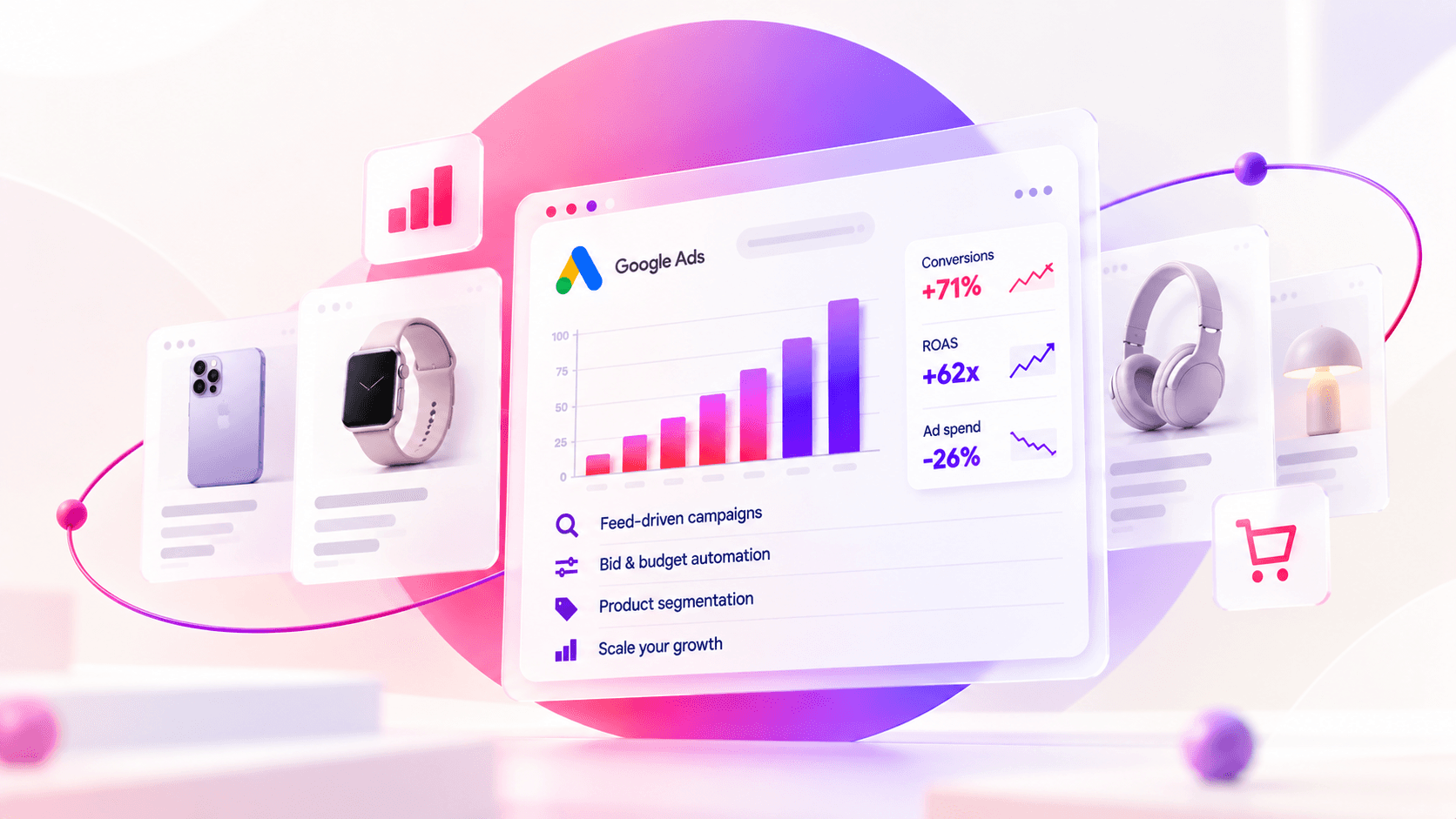
G-MOS is built for exactly this problem. It automates the creation and ongoing updates of Google Search Ads directly from a product feed, so campaigns reflect current catalog data without manual intervention every time something changes.
In practice, that means:
Thousands of ads generated from a live feed in minutes, not days
Campaigns that update automatically when prices or availability change
Centralized management of large accounts without proportionally growing the team
Bulk changes that run cleanly, without the errors that come from doing them under time pressure
Bid and budget management across large volumes
Visibility into which products are being deprioritized within campaign structures
For a PPC specialist, this changes how time is allocated: less on keeping campaigns current, more on performance analysis, account structure, and identifying growth opportunities.
Attribution and measurement: a growing gap
As Google Ads becomes more automated, measurement has become harder to get right.
According to Branch, 26% of companies currently cannot reliably track the user journey from first touchpoint through AI-powered search to final conversion. That gap is likely to widen as AI Overviews and generative search change how users discover and evaluate products before clicking an ad.
For PPC specialists, this is a practical problem. Running campaigns is one skill set. Evaluating whether they are actually driving business results is another. Last-click attribution underreports the value of branded search. View-through conversion data is often inflated. Incrementality testing adds complexity but is sometimes the only way to get a reliable read on what is working.
The specialists with the strongest position right now are the ones who combine technical fluency with Google's automated systems and the analytical skills to go beyond platform-reported metrics. That means knowing how to configure Smart Bidding correctly, recognizing when Performance Max is masking a structural issue, and running measurement approaches like holdout tests, geo experiments, or media mix modeling when the standard reports are not enough.
What this means for PPC teams in practice
The bar for managing Google Ads accounts effectively keeps rising. Automation handles more of the execution layer, but the strategic, structural, and analytical work has grown more demanding as a result.
For ecommerce teams specifically, accounts that are difficult to manage manually today will become harder to run as catalogs grow and competition increases. The specialists and teams that stay effective are the ones building workflows that combine automation tooling with clear measurement frameworks and solid account architecture.
The platform will keep evolving. The work that remains distinctly human is knowing how to direct it.
5 minutes
Posted by

Nadiia Prokofieva
CMO
Background in PPC and digital marketing, focused on Google Ads automation and eCommerce growth.