Google Marketing Live 2026: The Biggest Google Ads and AI Updates
Articles
Google Marketing Live 2026 made one thing clear from the start: Gemini is no longer just a feature inside Google Ads. It is the connective layer running across Search, Shopping, YouTube, Analytics, and creative production simultaneously.
Rather than announcing a collection of isolated tools, Google spent GML2026 showing how those pieces fit together into a more automated, more conversational advertising ecosystem. For advertisers and agencies managing Google Ads campaigns, the announcements have real operational weight, where some features are already rolling out, and others have firm deadlines attached.
Here is a breakdown of the most important updates and what they mean in practice.
Four New Ad Formats for AI Mode
The headline announcement was a new generation of ad formats built with Gemini for AI-powered Search. Google introduced four distinct formats, each designed to appear inside conversational Search journeys rather than traditional keyword-based results.
Conversational Discovery ads answer a user's specific question directly inside AI Mode. Gemini builds the creative in real time for each individual query, so instead of serving a pre-made banner, the ad responds to what the person actually asked. Both Conversational Discovery ads and Highlighted Answers include an independent AI-generated explainer alongside the advertiser's creative, and both carry a clear "Sponsored" label. These are currently in testing in the US on mobile and desktop.
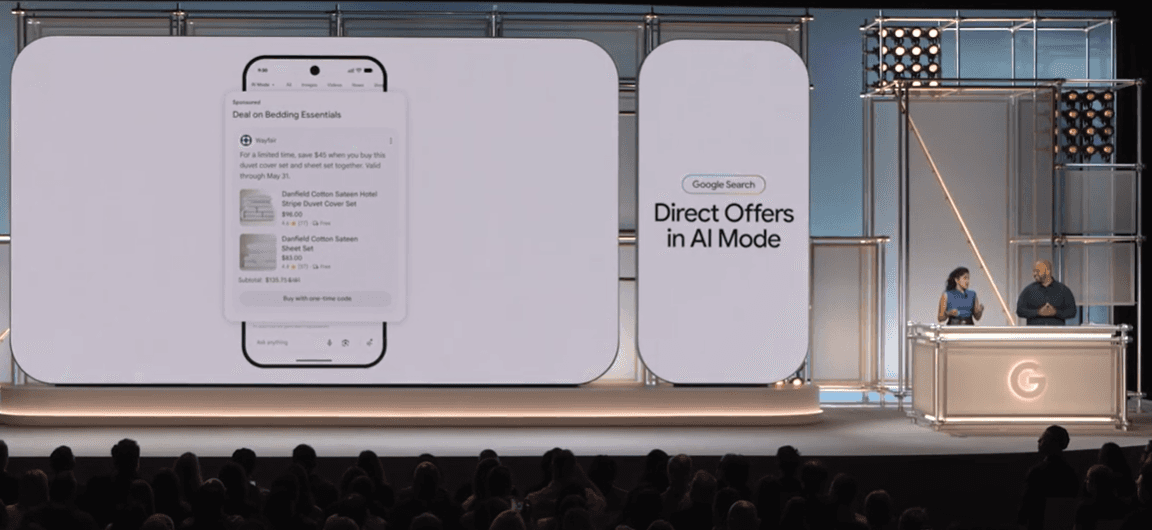
Google Marketing Live 2026: Direct Offers in AI Mode demonstrated live on stage.
Highlighted Answers work differently. When AI Mode returns a list-style response — recommended language apps for a trip, for example, eligible ads can appear inside that list as a sponsored entry. This format is currently being tested in the US.
AI-powered Shopping ads are coming to standard Search over the next few months. Rather than showing a static product title and price, Gemini pulls relevant inventory and generates a short contextual explainer for why a specific product suits what the user searched for.
Business Agent for Leads puts a Gemini-powered chat agent directly inside lead generation ads. A potential customer clicks "Chat" instead of filling out a form, asks questions, and gets answers drawn from the advertiser's website. This is launching in open beta for US advertisers with English-language accounts.
Alongside these four formats, Google expanded its Direct Offers program, which originally launched in January 2026. The upgrade adds promotion bundling (where Gemini assembles the most relevant deal for each search), native checkout for merchants connected to the Universal Commerce Protocol, and a travel expansion with Booking.com and Expedia. Direct Offers is a separate retailer program, not one of the four new ad formats.
Universal Cart and the Commerce Infrastructure Shift
One of the most significant structural announcements at GML2026 was the continued expansion of Universal Cart, which Google first introduced at Google I/O 2026 on May 19.
Universal Cart is a persistent, cross-merchant shopping cart that works across Google Search and the Gemini app today, with YouTube and Gmail support planned to follow later this year. A shopper can add a product while browsing Search, return to it later inside Gemini, and check out without leaving Google or transfer directly to the retailer's site. The cart monitors price drops and back-in-stock alerts automatically in the background.
The underlying standard is the Universal Commerce Protocol (UCP), an open industry standard Google co-developed with Shopify, Etsy, Wayfair, Target, and Walmart at the start of 2026. In April 2026, Amazon, Meta, Microsoft, Salesforce, and Stripe joined the UCP Tech Council — the governance body steering the standard — which Google described at the keynote as a sign of broad industry alignment. Klarna and Affirm are integrated for buy-now-pay-later. UCP-powered checkout is live in the US and expanding to Canada and Australia in the coming months, with the UK to follow.
Launch retail partners include Nike, Sephora, Target, Ulta Beauty, Walmart, Wayfair, and Shopify merchants such as Fenty and Steve Madden.
For ecommerce advertisers, the practical implication is straightforward: product feed quality, inventory accuracy, and pricing data are becoming more important than ever. Universal Cart and AI-powered Shopping ads both generate user-facing content dynamically from product data. Gaps in your feed — missing attributes, outdated pricing, thin descriptions — surface directly in what shoppers see.
Ask Advisor
Ask Advisor is a Gemini-powered assistant that spans Google Ads, Google Analytics, Merchant Center, and Google Marketing Platform from a single interface.
The practical pitch is straightforward: instead of switching between four separate dashboards to understand what is happening across a campaign, advertisers can ask questions in natural language and get answers pulling from all four platforms at once. Performance analysis, budget recommendations, campaign setup — Ask Advisor handles these conversationally.
For agencies running multiple accounts, the potential time saving is in cross-platform reporting and the back-and-forth that normally comes with piecing together insights from separate tools.
AI Brief and the AI Max Migration
Google introduced AI Brief as a natural-language control layer for AI Max campaigns. Advertisers write a description of their brand, audiences, tone, and creative guardrails in plain language. The system reads that input and generates campaign guidelines with previews, giving advertisers a structured way to shape what AI-driven campaigns produce without managing every individual creative decision manually.
The feature exists because Google has heard the same concern repeatedly: automation expands reach, but brand-sensitive advertisers want limits on what gets shown. AI Brief is the answer to that.
More urgently, Google is retiring Dynamic Search Ads in September 2026 and folding that functionality into AI Max. Any account currently running DSA campaigns needs a migration plan, and starting that process now is considerably less stressful than doing it under deadline pressure.
Asset Studio: Gemini Omni and 1-Click Creative Testing
Asset Studio received a substantial upgrade at GML2026, powered by Gemini Omni — Google's new multimodal model announced at Google I/O 2026, capable of generating video from text, image, and audio inputs.
Advertisers can now generate text, images, and video from natural language prompts inside Asset Studio. The workflow accepts marketing briefs, brand guidelines, website content, and campaign goals, then produces creative assets across multiple themes and formats. Gemini Omni specifically enables video creation inside the same interface, meaning teams no longer need separate tools to go from written brief to finished video asset.
The other notable addition is 1-Click Creative Testing, which automatically rotates asset variations and identifies which perform best against campaign objectives. New features are rolling out globally in English this summer.
For teams managing large campaign volumes, this changes the economics of creative iteration. Testing more combinations becomes cheaper and faster, which shifts the skill requirement away from production and toward briefing and creative judgment.
Demand Gen and YouTube Updates
GML2026 reinforced Google's position on YouTube as a performance channel rather than purely a brand awareness one. Google cited figures showing that 45% of YouTube Shorts viewers are not on TikTok and 65% are not on Instagram Reels, making the argument that YouTube reach is genuinely incremental for most advertisers.
New Demand Gen updates include creator partnership tools that surface relevant creator content featuring your brand directly inside campaign setup, creator video sourcing built into the workflow, Maps inventory integrations, and expanded measurement across placements. Google also noted that advertisers with large product feeds continue seeing stronger conversion performance inside Demand Gen campaigns.
Bidding, Budgeting, and Measurement
Several of the measurement and bidding announcements were less headline-friendly but carry real operational weight.
Journey-Aware Bidding is currently in beta for Target CPA Search campaigns in lead generation. It gives the bidding system more context about where a user sits in a decision process, rather than optimizing purely on the search query.
Demand-Led Budget Pacing adjusts daily spend dynamically based on predicted consumer demand. The system captures more volume on high-intent days and pulls back on slower days, while staying within the monthly budget. It is coming to Search and Shopping campaigns in the coming months.
Smart Bidding Exploration expands to Shopping and Performance Max, allowing campaigns to test less obvious queries and audience segments that may still convert. It is currently in beta for Performance Max.
Meridian — Google's open-source Marketing Mix Modeling tool — is moving directly into Analytics 360. The integration introduces a new metric called Qualified Future Conversions, which shifts measurement from backward-looking attribution toward predictive signals about which current conversions are likely to generate long-term value.
Google shared full details on bidding and budgeting updates in its official GML2026 bidding and budgeting overview.
Other Updates
Google also announced Message Ads with RCS for Business, which extends click-to-message ad formats into Rich Communication Services, enabling richer conversational interactions from ads rather than a basic SMS thread. Alongside that, improvements to Click-to-Call experiences and additional Search and commerce integrations rounded out the announcement list.
What This Means for Advertisers
The through-line across GML2026 was consistent: Google is moving execution further into Gemini's hands, and moving advertiser responsibility upstream toward goals, data quality, and creative inputs.
Feed quality is no longer just a Shopping concern. It now drives Conversational Discovery ads, AI Shopping ads, and the Universal Cart experience. Investing in better product data — richer attributes, accurate pricing, complete descriptions — has a more direct impact on ad performance than it did 12 months ago.
Creative work is changing shape. When Gemini generates creative per query rather than serving a pre-built asset, the skill that matters shifts from production to briefing. Understanding what inputs produce good outputs from AI Max is becoming a core PPC competency.
Automation is taking on more of the execution layer. Ask Advisor, Journey-Aware Bidding, Business Agent for Leads, and AI Max together cover analysis, bidding, lead qualification, and campaign management. What remains firmly in human hands is strategic direction, quality control, and knowing which guardrails to set.
And for anyone still running Dynamic Search Ads: September 2026 is closer than it looks.
Advertisers who want to go deeper on the announcements can watch the full Google Marketing Live 2026 keynote.
7 minutes
Posted by

Nadiia Prokofieva
Marketing manager
Background in PPC and digital marketing, focused on Google Ads automation and eCommerce growth.