How to build a high-performing Black Friday & Cyber Monday funnel with Claspo and G-MOS
Articles

Black Friday and Cyber Monday are among the busiest periods, when competition grows, and both traffic acquisition and onsite experience must be maintained with absolute precision. Brands are looking for effective ways to increase visibility and conversions.
In recent years, peak season strategies have changed significantly. Consumer journeys have become more complex. As a result, many businesses now rely on tools that help them automate processes and deliver a consistent experience from the first click to the final purchase. This is where Claspo and G-MOS complement each other.
G-MOS Google Ads automation platform ensures that search campaigns stay accurate and scalable for large catalogs with frequent updates. Claspo website pop-up builder maximizes onsite conversions through personalized user experiences that react to visitor behavior during sales season peak activity. In this article, we’ll cover sales statistics, outline key behavioral trends, and build a conversion-driven funnel for companies relying on online sales. The tactics showcased in this article can be successfully applied regardless of a high-demand period.
Why does a funnel approach matter during Black Friday and Cyber Monday?
The commercial pressure for brands grows each year, with rising acquisition costs and more competitive customer journeys. E-commerce businesses should ensure that their entire funnel performs consistently to maintain profitable growth. In peak season, shoppers evaluate multiple options before making a decision. At the same time, product availability and pricing often change several times throughout the day, increasing the pressure on marketing and ecommerce teams. To stay competitive, companies require a highly-performing funnel that drives relevant visitors and keeps them engaged on-site to convert intent into revenue.
The recent Criteo Black Friday Recap highlighted emerging changes in global e-commerce sales worldwide over the past years. In 2024, sales in Europe increased by 10% compared to the year before. Across the USA, online transaction volumes grew by 2% YoY. In Japan, over a third of retailers announced sales growth of 20% or more compared to the previous year. Cyber Monday saw stronger overall performance than Black Friday in the U.S.: online transactions surged by 9% YoY, and unit sales grew by double digits across multiple verticals.
These differences across different regions worldwide show how unpredictable peak-season performance can vary. Demand continues to grow, but shopper intent and spending patterns may change across product categories. That’s the main reason why brands shouldn’t rely on a single tactic or channel, especially considering that the season is in full swing and Cyber Monday and pre-Christmas shopping are just around the corner.
The same research showcased that peak season has shifted from one day of sales activity to a multi-week behavioural cycle. Buyers now start their research much earlier to learn prices and compare different options. The latest trend: 74% of online buyers start browsing more than ten days before completing their purchase to have enough time for decision-making. And almost 60% of online consumers interact with more than one brand before choosing. The acquisition costs continue to rise YoY, making it crucial to build a funnel before the season peak. This behaviour creates a customer journey that brands can no longer handle with a single tactic. Users are browsing longer and convert to customers only when the experience feels more personalised.
According to the Cross-Border Magazine’s Black Friday 2024 Global Sales report, e-commerce companies that offered early Black Friday deals had increased sales by up to 20%. The high season has evolved far beyond a one-day sales peak. Competition in the race for users and changing behaviours defines how brands must build their funnels: from acquisition to onsite engagement and final conversion.
Marketing funnel stages that determine peak-season success
The modern customer journey no longer reflects how shoppers behaved years ago; it’s not as linear anymore. Buyers are now moving dynamically and switching between exploring a few brands. Creating performance-driven funnels becomes more important because consumer attention is fragmented, and competition intensifies.
Consumers typically move through several stages:
1. Awareness
This is the point where the consumer encounters the brand for the first time through search results, referrals, ads, or content. The goal is to create instant relevance and spark curiosity. Strong visibility and the right messaging help the brand enter the customer’s initial consideration set.
2. Consideration
At this stage shopper begins actively searching for solutions and compares different alternatives and their characteristics. Users are considering while reviewing specifications and other details, like price, and while making their research, they might revisit the website even a few times.
3. Intent
Here’s the moment where users might come back to the exact product page and start initiating the cart process. This is the stage before making the purchase itself, so prices and availability are supposed to be clear, or the potential customer will shift to the competitor.
4. Conversion
User finalises his decision by making a successful transaction and completes his purchase. To prevent any disruptions, the process should be clear, with relevant information, and without any unnecessary steps.
The post-purchase funnel includes: Retention and Advocacy stages. This means that first-time consumers are becoming long-term customers. When they turn to the brand advocates, it strengthens the reputation.
Acquisition: Attracting high-intent traffic with G-MOS
While moving through this structure, at the Awareness stage, there’s a need to choose a strong acquisition tactic. It can be powered by multiple channels while brands are preparing for Black Friday and Cyber Monday. There are different types of them, like paid search, social media, email marketing, and affiliate traffic. All of them may drive volume, but not all guarantee high-performing results.
For companies and marketplaces operating large catalogs, Google Search ads remain one of the most efficient performance channels. But it is supposed to align with inventory changes and price updates. This is where traditional manual setups often fail during Black Friday and New Year's sales season. This may lead to gaps in relevance and cause budget waste. To prevent unpredictable clients’ loss, e-commerce websites worldwide are switching to automation. The G-MOS platform is designed specifically to ensure campaign accuracy and scalability even during extreme peak-season pressure and demand downtime periods.
How G-MOS helps to attract high-intent traffic:
1. Synchronization with catalogs.
The system automatically sends all data and makes instant updates in the ads due to the feed changes. It keeps ads relevant and prevents a bad user experience due to outdated information. Auto-update can be made up to 12 times per day.
2. Scaling due to the catalog growth.
While the quantity of items in the feed increases, ads can be generated by the system within minutes. KLR bus generated over 50000 just within 3 hours with the platform. This helps to scale ads while the catalog grows, without any errors or duplicates.
3. Stable performance even under extreme load.
During BFCM, daily catalog updates can reach multiple changes per day. Manual updates or traditional scripts cannot keep up with this process. The platform ensures that campaigns remain structured and consistent regardless of the update volume.
4. Automated structuring for high-quality traffic.
Well-structured campaigns with tightly matched keywords improve traffic relevance. G-MOS automatically organizes SKUs into structured ad groups and creates search ads using information from the product feed.
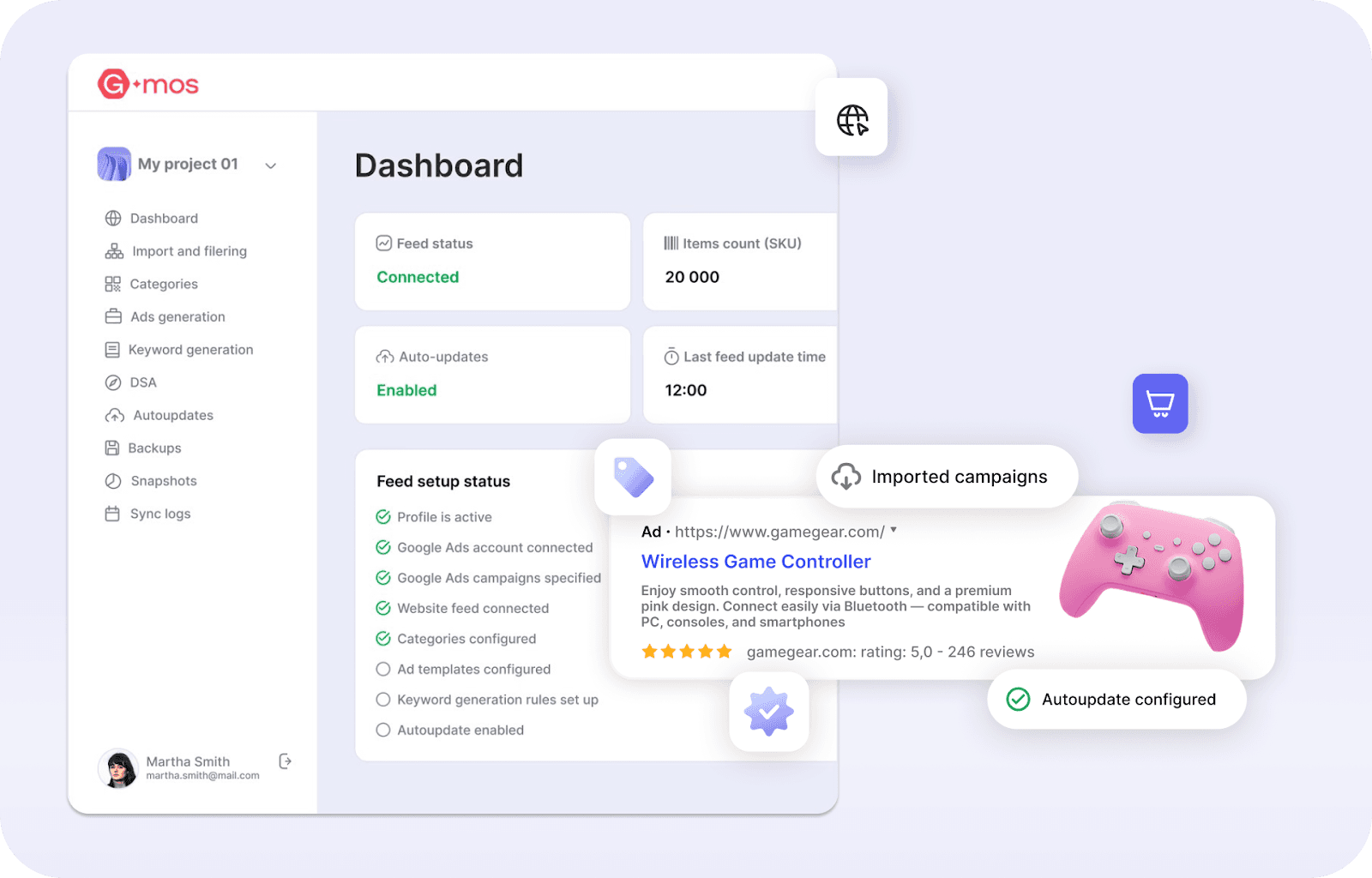
G-MOS interface and generated Google Search ad example.
On-site Engagement: Converting visitors into active shoppers with Claspo
Widgets can be integrated at the Intent and Conversion stages. On-site engagement determines whether clients stay and continue their journey or leave without any interactions. This may also affect search engine algorithms if the website brings a weak experience. During high-pressure periods like Black Friday and Cyber Monday, visitors expect clarity and a personalized shopping experience. Even a small drop in the user journey may cause them to abandon the session, especially when competitors are just a few clicks away.
This is the funnel stage where Claspo strengthens brands by transforming static websites into dynamic, behavior-responsive shopping environments. Claspo offers a wide range of widget types, including pop-ups, floating bars, floating boxes, content blocks, built-in widgets, and content-blocking widgets. Highly customizable templates are designed to build a personalized experience and can significantly increase conversions. These formats allow brands to engage different user segments with a relevant proposal.
On-site engagement trends are the following:
Customers expect dynamic experiences, not just passive browsing. The website experience should be personalized, eye-catching, and non-static. Interactive formats outperform static UX and lead to interactions.
Users now are scanning pages within minutes, quickly changing pages, and scrolling through them within seconds. Page elements might go unnoticed if they don’t fit users' behavior in real-time. To create a highly relevant experience for the website visitors, Claspo offers a variety of Black Friday templates: Limited-time offer forms, a Discount, and Sign-up Forms. Also, there’s a large library of available Cyber Monday widgets with no code requirements for setup.
One of the advanced recommendations explored by Claspo is that Gamified instant discount Pop-Ups can convert visitors into buyers. Moreover, according to insights adapted from their BFCM research, reward-driven pop-ups also contribute to higher average order value. Challenge mechanics or unlockable bonuses can motivate visitors to explore more items or complete additional steps.
Gamification turns on the emotional component and forces competition, growing the user's interest. Generally, it helps to strengthen the decision-making process.
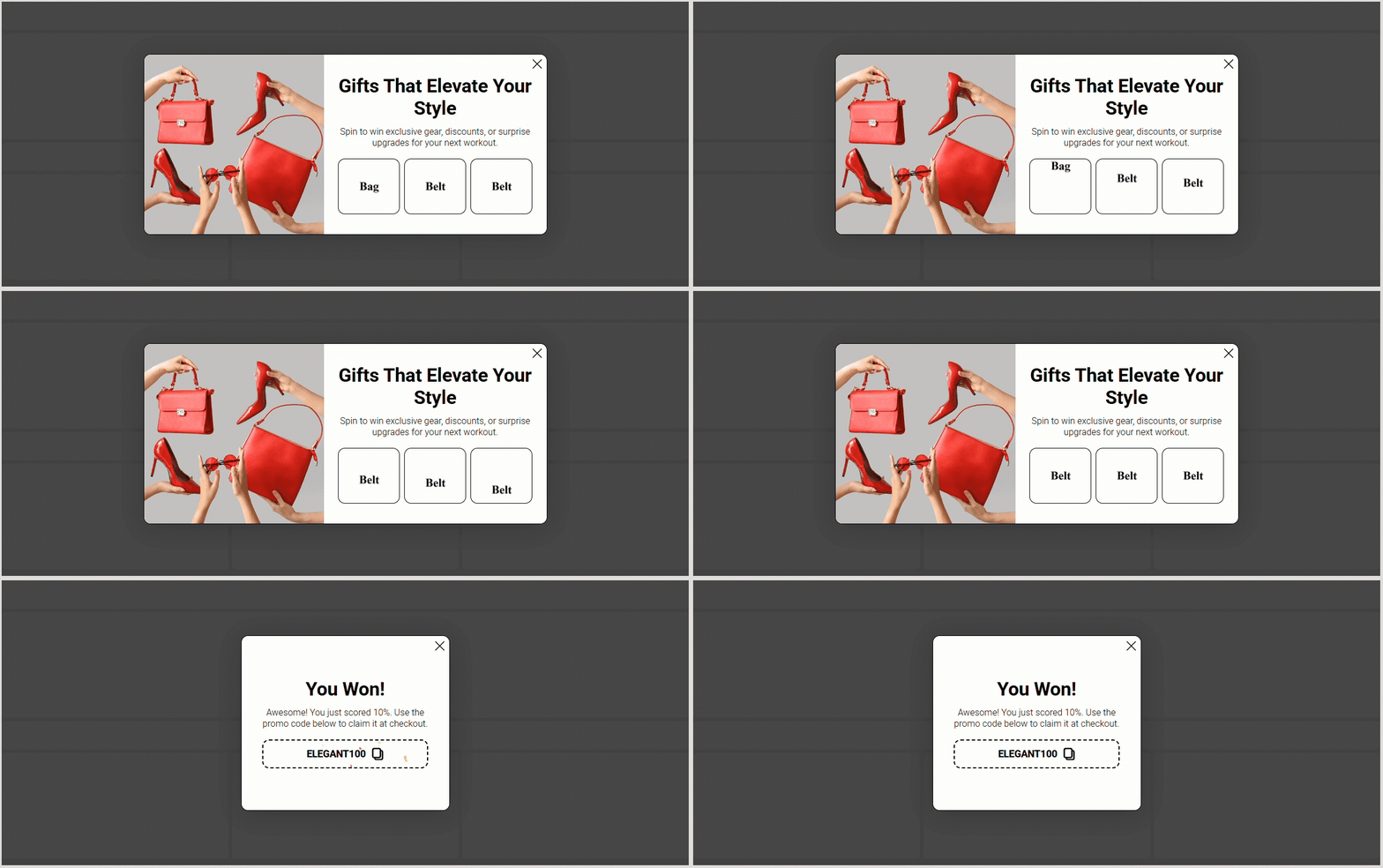
Claspo Gamified instant discount pop-up example.
One of the most effective solutions is making popups activate due on the user intent. For example, when a potential customer scrolls the page, moving through it or making some interactions. This approach helps to build a personalized experience and show a relevant proposal at the right moment.
Displaying behaviour-triggered widgets is more effective in preventing “banner blindness,” which has now become a common challenge. When messages appear at natural engagement points, users don’t perceive them as an interruption; it feels like a part of the experience.
The Conclusion
Building a high-converting funnel is a complicated process, and it might require the use of multiple channels that can be combined. The highlighted tactic that combines the Google Ads automation tool and the Website pop-up Builder solution might bring significant benefits and sales increase not only during the season peak but throughout the year.
Brands that embrace these technologies report an increase in conversions in both peak and slow seasons. They maintain user attention and deliver a personalised customer journey that supports sustainable long-term growth.
You may also like:
Zombie SKUs: How to detect and optimize deprioritized products in Google Ads?
Articles
Google Ads for consumer electronics e-commerce: scaling with G-MOS
Articles

G-MOS for the tire industry: Google Ads automation for online sales
Articles

Guide to generating product feeds from e-commerce platforms
Articles