Google Ads for consumer electronics e-commerce: scaling with G-MOS
Articles

The electronics niche is one of the global leaders in sales volume. Given that demand is dynamic and competitors are constantly striving to take lead positions, market players are in a continuous search for new opportunities. They expand their product ranges within existing categories and look for new ways to attract users.
In such a competitive environment, it is crucial not to miss potential opportunities and to test new approaches. One of the main challenges for major electronics retailers remains not just launching ads, but managing thousands of SKUs in real-time. When market prices change hourly, and a model's lifecycle is limited to months, manual management becomes a point of profit loss.
G-MOS automation platform has become an effective tool for optimizing Google Ads campaigns for the electronics industry. Search engine marketing for performance marketing is a key tool that has transformed significantly over the last 10 years, but has not lost its relevance.
The transformation of electronics advertising in Google Ads
The modern electronics market in Google Ads has long since evolved into a high-tech ecosystem where the success of a retail business depends on the ability to quickly update relevant data and changes. The global transformation of the niche is based on changes in buyer behavior and the rapid growth in the cost of each interaction.
According to Google's research for the electronics niche, the user journey has become significantly more complex compared to previous years. Analysis of users in Central and Eastern Europe showed that 90% of users search for products, and 44% research products online. User behavior analysis showed that 72% comes from Google Search, making this channel extremely promising for the niche.
Although the cost-per-click in electronics remains high, businesses see a high growth rate in AOV (Average Order Value). A high AOV allows for the offsetting of advertising costs, as each order generates more revenue. According to Triple Whale's Google Ads Industry Benchmarks, this figure rose by +9.11% on the eve of Q4. Consumers are increasingly choosing expensive, high-tech products (so-called high-ticket products), trying to invest in quality even before the start of mass holiday sales.
For a retailer, this means the battle is not just for a "click," but for a high-value customer. In such conditions, any technical error, for example, advertising an expensive laptop that is out of stock, leads to a wasted budget and the loss of potential users. When the average check grows, the precision of ad synchronization is critically important.
Google Ads PMax is convenient to use, but it is difficult to control. Advertisers hand over management to Google, losing control over the ad account as they previously had with the meticulous processing of Search campaigns and their subsequent clear optimization.
Over time, Google's algorithms are getting better, but they do not bring more control. Clients still do not understand how to get better results, where to find additional traffic, and how to convert it into sales without investing huge resources into processing and maintaining the relevance of large volumes of advertising campaigns.
This is where it’s worth going into more detail. G-MOS automates the most labor-intensive processes of setting up search ads for e-commerce, allowing for the scaling of campaigns without involving additional staff. Below, we will break down a step-by-step strategy: how to use our service to get extra traffic in the electronics niche and ensure 100% ad relevance with minimal operational costs.
Optimizing Google Ads Campaign architecture with G-MOS for electronics e-commerce
The electronics niche can be divided into several main keyword segments that users use to find what they need:
Model-specific queries: "Acer Aspire 7 A715-42G-R3EZ"
Category + Brand queries: "buy Acer laptop"
Category + Brand + Filter queries: "buy Acer laptop with RTX card"
A popular approach at the moment is launching PMax campaigns that cover all these types of queries, but they do not cover them completely. The problem is that semantics cannot be expanded in them, and there is a lack of management flexibility. As a result, these queries are covered at a basic level, but it is unclear whether they are delivering the maximum possible.
With G-MOS, it has become possible to build two parallel campaign structures within your ad accounts effortlessly. The first is PMax campaigns, and the second is standard Search campaigns that cover all necessary product categories and have detailed semantic processing.
With this approach, you give priority to Search in the account, as PMax uses Search as a last resort and essentially uses DSA campaigns, which have always served to support Search campaigns. Consequently, it is difficult to get additional traffic and equally difficult to control it.
What do detailed Search campaigns provide?
They let PMax know that there is no point in "entering the territory" of Search, as it will not be able to "support" with word forms what has already been processed and exists. With this approach, PMax concentrates more on Shopping campaigns, while regular Search campaigns pull everything possible from user search queries. At the same time, you fully control this process, can flexibly redistribute budgets, adjust strategies as needed, and, of course, can supplement semantics with new keywords for better returns. Ultimately, two internal structures provide the maximum that can be given.
There is only one downside: the high resource consumption for creating Search campaigns, as a separate group, ad, and semantics must be created for each landing page. Similarly, it is difficult to maintain the relevance of already created groups: a product in a category has run out, the price has changed, or a new brand has appeared in a category that needs to be identified and processed.
The G-MOS platform allows for the creation of groups with ads and semantics completely automatically; it also maintains the relevance of availability and product prices.
We recommend using the following approach:
Model-Specific queries
We use the standard Merchant Center feed.
From
<g:title>and<g:brand>, the group and keywords are created, and content for ad texts is taken. From<g:link>and<g:price>, everything else needed to create the ad text is taken.The result: each product is in a separate group, with keywords and texts. All updates on price and availability are automatically updated in your ad account.
Example of ad groups:
Laptops | Acer Aspire 7 A715-42G-R3EZ
Smartphones | Apple Iphone 11 256Gb
Example of keywords:
Acer Aspire 7 A715-42G-R3EZ
A715-42G-R3EZ
Aspire 7 A715
iphone 11
buy iphone 11 256 gb
iphone 11
Example of ads
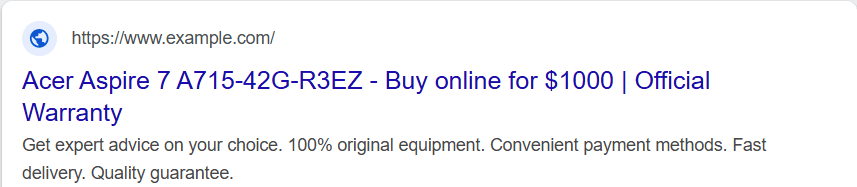

Now all website models are displayed both through PMax in Google Shopping and in the regular search results with text ads. This approach significantly increases the probability of a click-through to your resource and, at the same time, minimizes the risks of the brand's complete absence in the search results. It is important to consider different user behavior: part of the audience focuses only on visual product ads in Shopping, while others prefer the classic Search campaign results. In this case, you adapt to everyone and will be able to show your products in full in all formats of search results.
Category + Brand type queries
Category + Brand + Filter type queries
We use a similar feed structure, but we pass information from the site's pages of these levels into the <g:title> and <g:brand> tags, while passing the landing page with the product listing and the current lowest price from the assortment into <g:link> and <g:price>.
If you set up such data transfer into separate feeds from the website, all categories of these levels of the site will be processed; groups, semantics, and ad texts will appear for all of them, and all of this will be done automatically. Further, as in the example of the model feed, the availability of products on the landing page is maintained. You can set a minimum number of products at which the system will consider the category products to be sufficiently represented on the site; if there are fewer products than the specified value, the group with this landing page will be paused. Similarly, the transfer of the lowest price for a selection of products will always be relevant if it is passed from the site via the feed.
Example of ad groups: Laptops | Acer Smartphones | Samsung
Example of keywords:
buy Acer laptop
Acer laptop
samsung smartphones
buy samsung
smartphone samsung
Example of ads


Now all categories and priority filters are processed, and the advertising account is synchronized with the website. A foundation has been laid in the form of a flexible, detailed structure that can be worked with by expanding semantics and managing budgets and strategies.
By the way, it would take about 6 hours to process all categories and all models for a site like comfy.ua, for example, of which only 1 hour would be manual work — this includes creating the campaign structure and setting up the feed processing; everything else is done automatically. Furthermore, there is no time spent on updating campaigns, as everything works automatically, with updates occurring up to 12 times a day.
This approach ensures an increase in sales volume by creating a large number of entry points to your website and using the most relevant keywords, from model-specific queries to the category + brand level. One of the greatest advantages is that only the current, up-to-date offers from the website will be displayed.
Client success stories: Google Ads performance in electronics e-commerce
For example, processing all categories and all models of a site like comfy.ua would take about 6 hours, of which only 1 hour would be manual work, creating the campaign structure and setting up the feed processing. Everything else is done automatically. And thereafter, there is no time spent on updating campaigns, as everything works automatically, with updates occurring up to 12 times a day.
Such an approach ensures an increase in sales volume because you create a large number of entry points to your site and use the most relevant words from model-level to category + brand level. One of the biggest advantages is that only relevant offers from the site will be displayed.
Companies such as Comfy, Foxtrot, and Moyo achieved high marketing indicators thanks to the integration of the G-MOS system for their ad campaigns. Companies in the electronics industry generate between 5% to 30% of additional transaction volume permanently through G-MOS, according to specified KPIs.
All that is necessary is to work with campaign budgets and strategies for high-quality processing of incoming traffic. Meanwhile, the platform takes full responsibility for maintaining the relevance of campaign content.
When there are thousands of electronics units in the assortment, manual management of bids and ads becomes problematic. Algorithms allow for the automation of this process, which is critical for large e-commerce projects. A striking example of how automation affects profit is the case study on increasing Google Ads revenue for Exist.ua in the automotive parts and tires niche.
In addition, G-MOS offers another key function: automatic control of bids and budgets for Search, Shopping, and Performance Max campaigns. The system independently analyzes statistics and makes adjustments or suggests them for manual entry. This ensures the automatic redistribution of the budget in favor of the most profitable items.
Success in the electronics niche depends on a company's ability to combine strategic marketing vision with powerful technological tools. It is this synergistic approach that opens new opportunities for scaling and allows advertising campaigns to work at the peak of their performance.